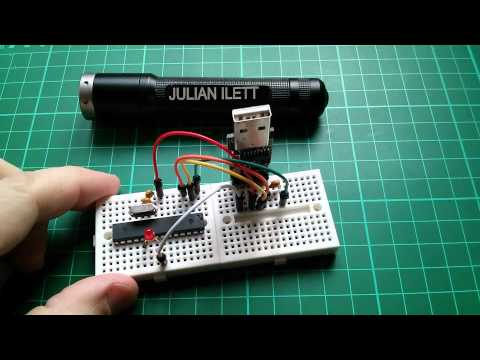
1 1-Day Project: Build Your Own Arduino Uno for $5
Julian Ilett builds a standalone ATmega328P Arduino for about five dollars, a common starting point for people making their own Arduino-compatible boards.
Channel
15 recommended videos. Channel on YouTube
Julian Ilett builds a standalone ATmega328P Arduino for about five dollars, a common starting point for people making their own Arduino-compatible boards.
Linked when a cheap constant current LED driver module comes up, mainly for its demonstration of the module's PWM dimming input.
A brief beginner-level MOSFET video, part of a longer series, suggested to Arduino users whose transistor switches run hot or refuse to turn fully on.
A comparison of three USB to serial adapters that people point to when programming a Pro Mini or bare clone board without onboard USB.
A short introduction to the nRF24L01 radio module that gets suggested when someone wants cheap wireless links between Arduinos.
An introduction to cheap LM2596 step-down converter modules, linked for anyone wanting to understand what these boards do before buying one.
Julian Ilett examines the TP4056 lithium charger module with DW01A protection; cited for its fixed cut-off voltage and for using the output while charging.
A six part MOSFET tutorial series by Julian Ilett, suggested as a gentle introduction to how these transistors switch loads in Arduino and hobby circuits.
A practical guide to wiring a small I2C OLED to an Arduino, including a warning about setting the display address correctly.
A frequently cited explanation of changing Arduino PWM frequency with a dedicated library, the second part of a PWM tutorial series.
Walkthrough of the TP4056 lithium charger module in use, cited for showing battery connection and charge behaviour on an older board revision.
Apparently a review of a multi cell lithium power bank, linked in discussions about charging and combining cells, with no opinions given on the video itself.
Julian's follow-up on two-pin colour-changing LEDs, explaining how the tiny built-in chip is pulsed to switch colours, relevant to Christmas light strings.
Recommended as a tutorial on bootstrapping the gate so an N-channel MOSFET can switch the high side of a circuit.
A detailed look at the RC522 RFID reader module and how to use it with an Arduino, praised as a clear explanation of a fiddly part.


